By Harshal Kiran Joshi

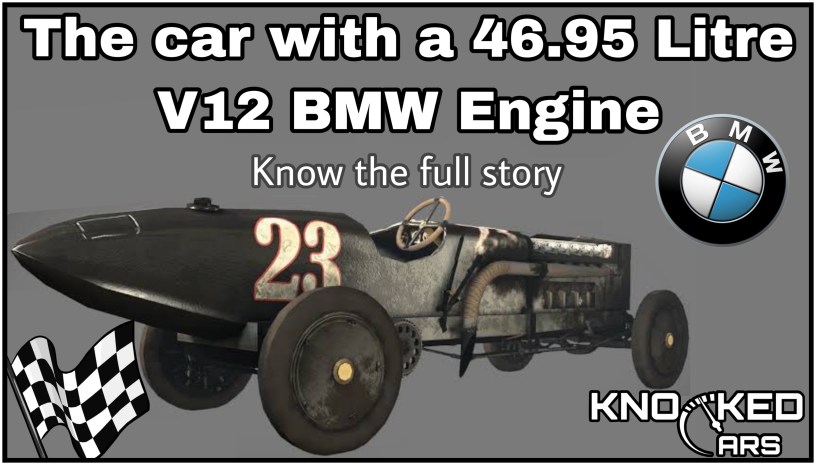
This is an Aircraft. It’s the Kawasaki Army Type 92 Biplane fighter, one of the many airplanes that used a BMW engine, a big BMW engine. Now when I say big, I’m not talking about a 6.3L V8 like we have these days, I’m referring to a crazy 46.95 Litre V12 built by BMW during the First World War. This engine was called the BMW VI and it made 750 hp at only 1700 rpm which is a very high power output for the time. Like I said this engine was used in a lot of aircrafts over the years but someone also came up with a frankly crazy idea, and it was to install this engine in a racecar, giving birth to what we today know as The Brutus.
After the First World War, many aircraft engines were easily available in Germany as they were not allowed to have an air force; this gave the perfect opportunity to some motorsport enthusiasts, who decided to use this engine in a racecar at Brooklands which is a racetrack in the UK and one of the oldest racetracks around the world.
A chassis with a 1907 chain drive was used as the base for this experiment. This chassis was used by fire departments in the US for a long time. The 47 Litre BMW VI was bolted to the chassis, and since brooklands had banked curves, powerful brakes weren’t needed and thus the car was fitted with only rear brakes (#WeightReductionBro).


Adding to the weirdness of this engine, the cylinders on the right side each had four litres of cylinder capacity, whereas the opposite only had 3.82 litres each. This was because it was operated with six main and auxiliary connecting rods, thereby a causing rods to be of different sizes. This design that was very popular at the time because it saved space and weight.
Speaking of the Brutus itself, like I said the brakes only acted on the rear axle, and the power output from the engine was delivered to the axle by a three speed gearbox and a chain drive. That’s all very good and useful information, but what did it sound like, here are some clips.
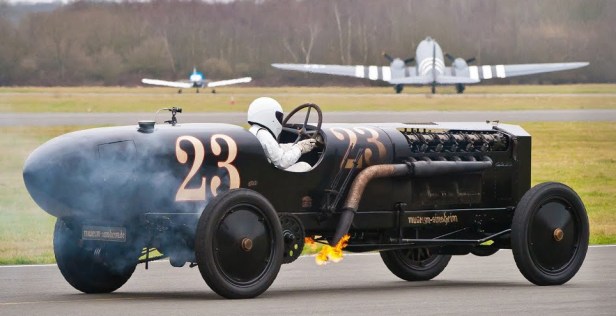
Speaking of safety, there was basically none, the driver sat just behind the engine, separated from heavy moving parts by only a metal grid. The driver was also directly exposed to the engine heat and any leakages. Speaking of top speed, it is claimed that the brutus is capable of hitting over 200km/h, however there’s only one person who has ever tried this. Roger Collings from Wales raced at 200 km/h on the high-speed oval of the Bosch test track in Boxberg. Apart from Roger, no one else has attempted this, I mean why would anyone want to go that fast in a car with no front brakes and bicycle tyres.
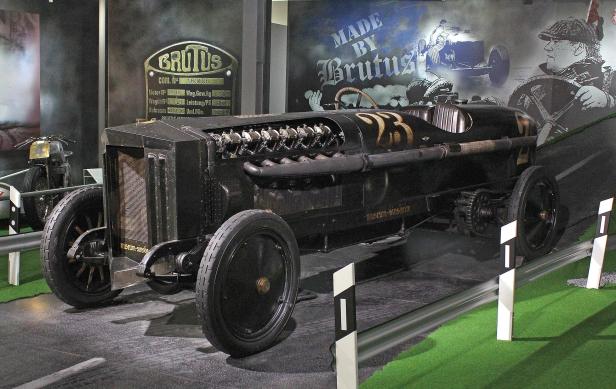
The Brutus now sits in the Sinsheim Technik Museum in southern Germany. The car is also exhibited in various vintage car rallies and car shows across Germany. What are your views on this historical masterpiece? Let me know in the comments!
Watch the Brutus video on our YouTube Channel.
 Knocked Cars