by Tojo Tonny
Mercedes stands for absolute luxury, the aspirational value it holds is exceptional. BMW for it’s fun to drive characteristics, Audi stands somewhere between. While the Sweden maker Volvo, is synonym of Safety.
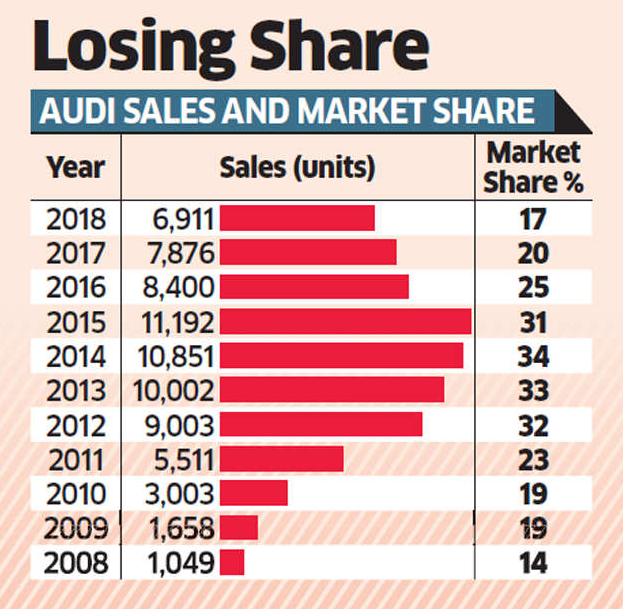
On a lighter note, it’s really appalling to see Audi’s strategy for Indian market! From being a fierce sales champion to the least interesting among the luxury marques. Everything’s been a downfall ride for Audi India since 2016! With increasing competition and new entrants, being radical and up-to date with offerings is the only way to stay relevant in the market. Other than the Matrix LED headlamps there’s nothing innovative of Audi today! Quattro is great but everyone’s catching up now.
A 1.4 TSI in a 40+lakhs car? Less said about the cousin Skoda Superb, the better. Product-to-product the latter is a better option(minus the brand value). May be, not everyone needs a enthusiastic car but then you”ll have to offer something else to drool the customers.
Right now the market preference is set.
For the luxury and brand conscious- Mercedes it is!
For the enthusiasts- There is BMW.
Earlier, Volvo was a name associated with boxy designs. An old man’s car, they said! The new design-language has totally transformed their appeal. In India, Volvo is associated with bus and trucks! A car with a Volvo badge is rare in India. In fact, many in India don’t know that Volvo is into cars too!

The innovations that Volvo introduced to the automotive scene is largely left unknown.

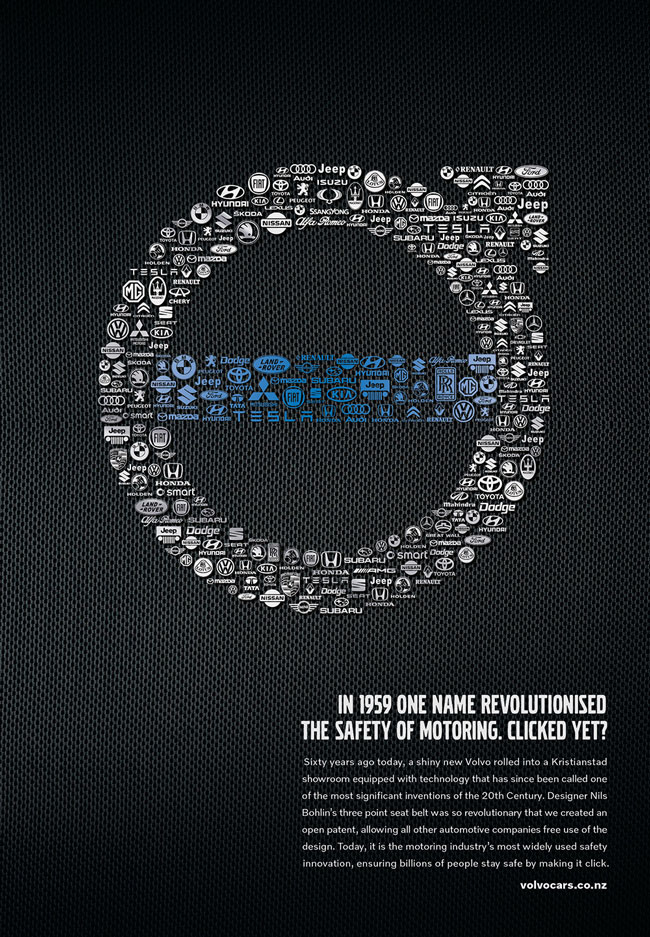
From the 3-Point seat belt to the autonomous braking systems and the rearward facing child-seats! Volvo has been and continues to be the pioneer in the field of Safety!
In the meantime, while in the race to increase the bar in terms of safety, Volvo also had some tasty plans! A need for a performance division! 2015 and Volvo bought the Polestar division to complement it’s Performance dreams! But, before going to Polestar. Let’s slow down a bit.
1.1. Volvo S60 AWD:
Before the coming of Polestar, Volvo had another exciting offering in India. It was the Volvo S60 AWD! 304BHP and 440NM of torque! It was a true Wolf in Sheep’s Clothing!

This was in 2011. Back then in India, Volvo didn’t have the brand value or aspiration associated with the Germans. So, to make your arrival grand you’ll need something out of the box! The S60 AWD was that!
A 3L In-line 6-Cylinder turbocharged Petrol engine with AWD, and several features un-heard in the segment. Being a Volvo, a 5-Star rated safety can be taken for granted! Since it was a CBU(Completely Build Unit) the quality was top-notch. Volvo priced it decently well for a CBU undercutting it’s rivals at 34L in 2011.
OT- Toyota should learn a thing or two from Volvo on pricing it’s CBU products! With all due respect to it’s durability, the Landcruiser is priced obsequiously high! They now have plans of bringing the Mark V Supra to India through CBU route! *Fingers crossed*
1.1.1. Engine:
Volvo’s prime competitors were the BMW 330i, Audi A4 3.2 and the Mitsubishi Lancer EVO X. The BMW is undoubtedly sporty with it’s legendary handling capabilities, The Lancer EVO shared it’s rally experience to offer a finesse experience. But what made the Volvo stand out was the way the engine was tuned, it was aimed to make an impact.

3.0L In-Line 6 Cylinder engine rated at 304BHP and 440NM of torque. To bring things into perspective, the car next to the S60 had only 360NM of torque. Torque is what makes the difference in acceleration and the S60 had it in oodles!
An in-line occupies much more space than a V with same cylinders. But why did Volvo choose this configuration? Cost effectiveness? Less complex? Remember the S60 AWD shared it’s platform with the Ford Mondeo. The other maker which is popular with in-line engines is BMW.
*Minutiae*- When Mitsubishi bought the Lancer EVO X to India, they offered a warranty period of just 6 months/10000Kms. Remember its a 50L rupee car!😲 My smartphone has a much better warranty🙄
1.1.2. AWD, LSD and Dynamics-
RWD offers more fun than a FWD. But the sheer grip that AWD offers is un-matched. Strut-bars, suspension tweaking, nothing can match the way a perfectly calibrated AWD car sticks to the road!

The S60 used a Haldex system with a limited-slip differential.
1.1.2.1 So what is a LSD(or Limited-Slip Differential)?
Under normal condition with best grip on offer, the LSDs have nothing to do. But under conditions like snow, rain or taking sharp turns at high speeds it’s natural that not all wheel have proper traction. In such conditions, a LSD routes more torque to the wheel having the most traction. This prevents unwanted wheel spin.
The popular quote- ‘Less Traction, More Action’ is true only when you wanna have some fun. When it comes to clocking blistering lap times, loss of traction is your greatest enemy!

1.1.2.2. What does LSD do in track?
In a race track hitting the perfect apex goes a long way in making a perfect lap time. Exiting the apex can be more tricky if you mess with the throttle input. This is where the LSD shows it’s might! The LSD would route more power to the outer wheels which lowers the inner wheel’s spin in a turn. This allows the driver to gun the throttle sooner while exiting the apex.
1.1.3. Interiors:
Volvo models today like the S60, XC90 all use a huge touchscreen to control multimedia and lot other functions. However, older S60 had a more minimalist approach. It did have a screen of decent size but it wasn’t a touchscreen unit. The dashboard is driver-biased having a slight towards the driver.

There were tons of button in the center console. Most of the operations were carried out using these buttons. At the lower part of the console there are three buttons to control the drive modes- Comfort, Sport and Advanced. These are accompanied by buttons to activate/deactivate other passive safety features of the car like front parking sensors, BLIS(Blind Spot Information System) and lot more.
Today when most cars are devoid of any buttons, cars like these have a sweet spot! It’s only in the initial days that the buttons appears to be cluttered and cumbersome. After getting used to, they work like charm!
1.2. Dawn of the Polestar in India:
It was in 2015 that Volvo bought 100% stake at Polestar. This was aimed at producing exclusive high-performance variants of Volvo cars right from the factory, Polestar will also power the future performance series of electric vehicles that Volvo produces.

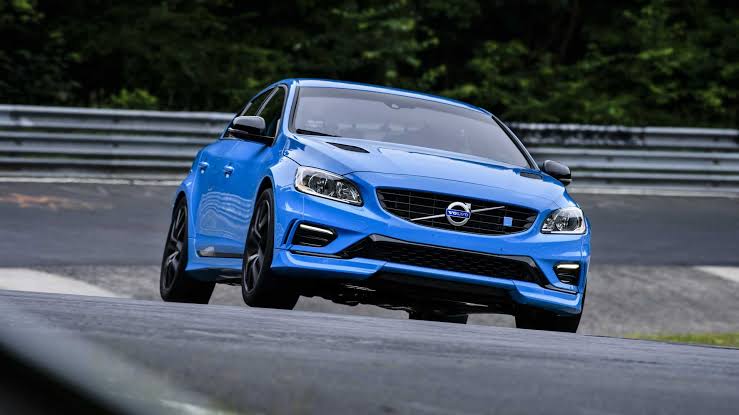
Before a full-on Polestar variant was launched, globally Volvo offered R-Design to its line-up. It was a beefed-up version of their standard cars just like BMW’s M division and Audi’s S Line. But, it was only in 2015 that Volvo got serious with Polestar and the S60 Polestar was the outcome.
When Volvo launched the S60 AWD in 2011 it was priced at 34 Lakhs while the S60 Polestar in 2017 was priced 52 Lakhs. Both prices ex-showroom and key factor to consider is that they are CBU meaning they extract high import duty.
The S60 Polestar produced 372HP and 470Nm of torque using a 4-Cylinder Twin-Turbo 2.0L petrol engine.

The engine is electronically limited to a top speed of 250Kmph and has an official timing of 4.7Secs to reach the ton. It’s possible considering the power at disposal.
To differentiate from the regular S60 the interior wears a polestar unique shade- a tinge of blue everywhere. The steering has a blue stitching, the analogue rpm meter is replaced by a digital instrument cluster, aluminum cover for the pedals to add sportiness. The major addition is the paddle shifters finished in aluminum. Even the S60 AWD lacked it. A paddle shifter goes a long way in amplifying driving experience.

With so much power there is another issue which is possibly a very important factor- the ability to put down the power properly to the ground.
For this, the chassis has undergone very extensive rework. Carbon-fiber strut bars, stiffer suspension and Öhlins dampers. Öhlins is among the top performance parts supplier like Bilstein. The Öhlins dampers can be adjusted manually for different driving conditions.

It used a 8-Speed torque converter unit(AWD had 6-Speed) and BorgWarner AWD system with ability of torque-vectoring. What it actually does is monitors several parameters like engine speed, gear, throttle inputs, G-Force in play and multitude of other functions and applies more torque to the outer wheels exuding in cornering capabilities. The function is similar to how a LSD works but lot more complex in action. By now it is clear that the Polestar is not a simple sticker job to pose as a halo product, it is a Serious Performance Machine.

Threat to the AMGs and Ms? Uh-mm, kinda but back then Volvo had only handful of dealers and service centers though it has changed now. Performance vehicles like these require attention from people who know them inside-out. This wasn’t meant to be a cash-cow or sales topper. After all, Volvo had allocated only 30 Units for India out of the 1500 units produced globally. It screams EXCLUSIVITY.

20-Inch alloys and a low-profile tire aid handling and boast the overall sporty quotient. But for Indian road conditions, perhaps they can cause a deeper hole in your pocket sooner or later. For the price it was offered back that it was a steal considering the fact that it’s a proper high-performance machine and also a CBU.
Cyan Racing- Scandinavian racing team played a crucial role in developing the S60 polestar. The S60 Polestar concept used a In-Line 6 cylinder engine producing staggering 508hp and 575Nm of torque!

Today, Volvo offers a slew of vehicles in India. From XC40 to the Plug-in hybrid variants of XC90. But a Polestar treatment from Volvo is yet to be seen since 2017. Only time will tell if the ultimate fun tool will have a second life in India. If it does, then it’s sure to demoralize its competitors.
Cheers,
Tojo Tonny
 Knocked Cars